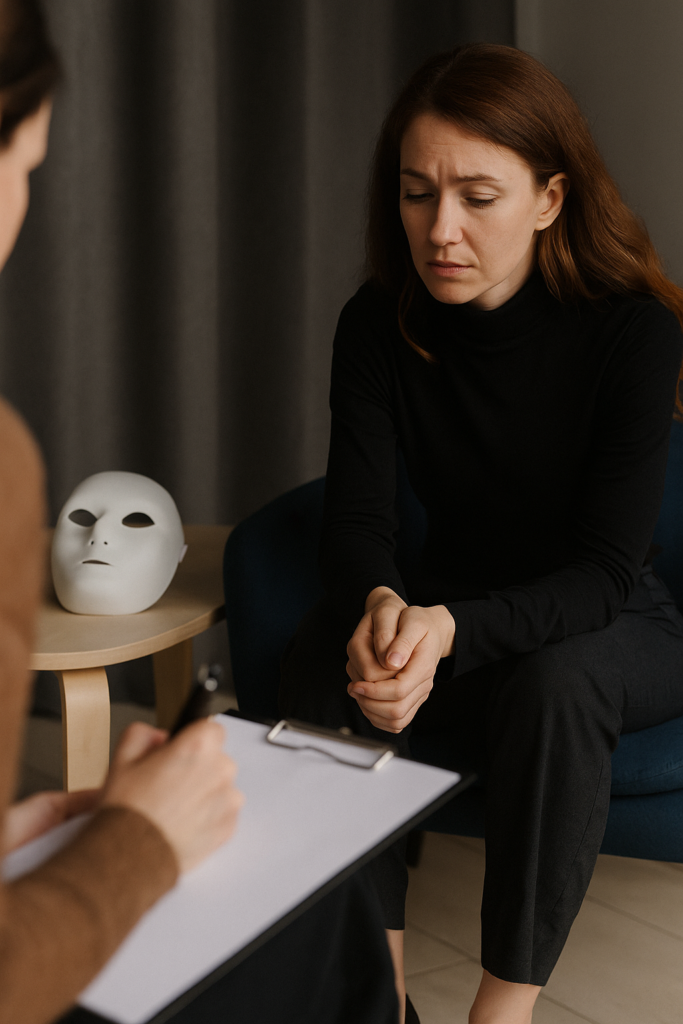
🎭 You don’t have to translate yourself here. Not into something palatable. Not into something poetic. You don’t have to be brave, articulate, or creative.
You can show up quiet. Messy. Raw. This space isn’t asking for performance — it’s offering presence.
Confidentiality is sacred. This is where the spotlight turns off — and your nervous system, your truth, and your tired parts finally get to rest. No roles. No applause. Just you.
In the world of performance, needing help can feel like weakness. You’re trained to hold it together. To stay in character. To be available — to directors, to audiences, to energy that moves through you. But what happens when you can’t shake off a role—even after the final scene? When the emotions stay in your body longer than they’re supposed to? When you start to confuse the part you played with the person you are?
Many artists silently carry: • emotional residue from past performances • roles that triggered personal wounds • anxiety masked as “creative energy” • deep fatigue they can’t explain — but feel in their bones And often, the world doesn’t see it. Because from the outside, you’re doing great.
This space is different. It’s not about fixing. It’s not about judging. It’s about allowing. Here, you don’t have to justify your sensitivity, intensity, or process. You don’t have to be “on.” You get to explore what’s happening in your inner world — in a confidential, non-performative, therapeutically held space.
Even if the world sees your spotlight, you still deserve a backstage — for your mind, your body, and your truth.
What this can look like…
She came to therapy after playing a woman who loses her child. A decisive, demanding role. Critics praised her. But weeks after the show ended, she still couldn’t sleep. She felt empty, raw, and tearful without reason. “I knew it was just a role,” she said, “But my body didn’t seem to know that.”
Or the actor who always got cast as the aggressor, and started carrying shame he didn’t understand. Or the singer who lost her voice every time she had to sing something emotionally close. Or the dancer whose back pain wouldn’t stop, no matter how much she stretched.
These aren’t just “artistic blocks.” They’re the body’s way of asking for space. For repair. For someone to witness what has never been seen.
In Embodied Expression Therapy, we don’t dissect your craft. We hold the human behind it. This work honours your emotional range and helps you return to your centre, again and again.
Will this therapy weaken my creative fire?
Absolutely not. In fact, many artists report feeling more connected to their craft after therapy — not less. Because when you’re not constantly carrying unprocessed emotions, roles, or tension, you gain access to a deeper, cleaner well of expression. Your nervous system has more flexibility. Your boundaries are clearer. And the art flows with less emotional cost. This work doesn’t dull you. It protects the part of you that brings your work to life.
What if I don’t want to talk about my childhood or personal life?
That’s completely okay. We go where you’re ready. Sometimes, the session begins with how your last rehearsal felt in your body. Sometimes it’s about stage fright. Sometimes it’s about grief, identity, or boundaries. This is your space — we co-create it with care, not pressure.
What if intensity is part of what makes me a good artist?
It is. Intensity is not the problem. It’s the absence of recovery that hurts. This work doesn’t ask you to give up your depth. It offers you an inner anchor — so you can go deep without losing yourself. Think of it like this: the more safely you can return to your body, the further you can travel through expression.
What a Session Looks Like
Every session is unique — just like your body, your process, and the role you’re coming from (or heading into). Some days, you might come in still vibrating from a performance. Other days, you might feel flat, numb, or exhausted from being “on” too long. Here’s what working together can include: • Grounding and regulation — especially if you’re feeling overwhelmed, overstimulated, or unmoored • Tracking body sensations that linger after certain roles or rehearsals • Exploring what part of you got activated (emotionally, relationally, symbolically) during performance • Naming emotions that don’t yet have words — or maybe were never yours to carry in the first place • Working with breath, posture, internal permission, and embodied presence — gently and safely • Reflecting on boundaries between you and the character, or between the performer and the person
You don’t have to arrive “ready.” You don’t have to be eloquent, inspired, or even clear. You just have to show up. The rest, we discover together — slowly, respectfully, and in a space where you don’t have to perform.